It happens across the SEO industry every single day. An agency runs a campaign for four months. They audit the site, resolve the indexing errors, map the content architecture, and build the foundational links. The impressions are starting to climb. The leading indicators are all pointing in the right direction. And then, the agency receives a cancellation email from the client.
The campaign didn’t fail because the technical execution was wrong. It failed because the client never actually understood what the execution was building toward. The seeds of that catastrophic cancellation were planted long before the first link was placed, before the first content brief was ever written, and before any deliverable changed hands.
Here is the uncomfortable truth about running an SEO agency: Most SEO campaigns are set up to fail in the very first conversation. Not in the first month—the first conversation.
In a typical agency setup, the scope is vague. The success metrics are assumed by both parties, not mutually agreed upon. The timeline is presented as a hopeful promise, not a structured milestone map. The client’s fundamental understanding of what SEO actually does is shaped by what they read on a competitor’s aggressive landing page, not by a structured, deliberate education process led by you.
The single highest-leverage action an SEO agency can take to drastically improve retention, reduce mid-campaign conflict, and ultimately produce better organic results, is investing in a highly structured SEO client onboarding framework agency model that happens before the work begins.
This is not a welcome email. This is not a PDF attachment of upcoming deliverables. It is a deliberate, sequenced process that precisely defines scope, sets unmovable milestones, educates the client, and creates a shared framework for measuring progress.
By the end of this article, you will have a complete, 5-stage onboarding framework. You will understand exactly what each stage is designed to prevent, and you will know exactly how to onboard SEO clients for your next intake, transforming your agency from having campaigns fail silently to running a process so clear the client never questions it.
Where SEO Campaigns Actually Break Down
Most agencies conduct a post-mortem on failed campaigns by forensically examining the work. They look at the links built, the content published, and the technical fixes applied, trying to figure out why the client wasn’t satisfied.
This is entirely the wrong place to look. The work itself is rarely the primary cause of early campaign failure. The cause is almost always a structural gap created before the work ever began.
Gap 1: Scope Was Never Precisely Defined
What is actually included in this engagement? More importantly, what is explicitly not included? What does the agency need from the client to execute correctly—and what happens to the timeline if those inputs are not provided?
Most standard SEO scope of work documents answer the first question and completely ignore the second two. The result is that both sides operate under wildly different assumptions until operational friction makes them visible. This usually happens at month 3, when the client asks why a landing page hasn’t been redesigned, assuming “SEO” meant “web development,” and you have to awkwardly explain that CRO and design were never part of the retainer.
Gap 2: Success Was Never Agreed Upon
What is the actual goal here? Is it raw keyword rankings? Organic traffic volume? Qualified leads? Bottom-line revenue?
The agency’s definition of SEO success and the client’s definition of success are frequently different, and they are almost never explicitly compared before the work starts. Without a shared, documented definition, every single monthly report is open to interpretation. The agency presents technical progress; the client sees a gap between what they expected (immediate leads) and what they see (crawlability improvements). That gap grows every single month until the relationship collapses under the weight of it.
Gap 3: The Client Was Never Educated
Most clients arrive at an SEO engagement with a surface-level understanding shaped entirely by marketing copy. They know SEO is important for their business. They do not know what it actually does, how long different outcomes take to materialize, what they need to provide to make it work, or what the difference is between a campaign that is building capacity and one that is failing.
The agency that treats client education SEO as the client’s problem to solve has effectively outsourced their primary retention risk to the client’s Google search history. If you do not educate them, they will educate themselves—usually with terrible, outdated information.
Gap 4: The Agency’s Process Was Never Made Visible
What exactly happens in month 1? What about month 3? What are the specific triggers for a strategy adjustment? What does the agency do when something isn’t working as expected, and how does the client know that this issue has been identified and is actively being addressed?
Clients who cannot see the underlying process default to measuring the only thing they can see: flagship keyword rankings. When those rankings inevitably do not move in the first 60 days, they conclude nothing is happening. The agency that makes its internal process highly visible removes this anxiety entirely.
What Most Agencies Call Onboarding — And Why It Fails
Take a critical look at the average agency onboarding process. It typically consists of four things: a contract, a 45-minute kickoff call, a request for Google Analytics and CMS access credentials, and a first-month deliverable plan.
Some agencies might add an automated welcome email. A few might add a slickly designed “what to expect” PDF. None of these actually constitute a structured onboarding system, because none of them close the four critical gaps identified above.
A contract defines commercial terms and legal liabilities. It emphatically does not create a shared understanding of what the digital work is building toward.
A kickoff call covers logistics. It asks who the main point of contact is and when the weekly meetings will be. It does not systematically educate the client on how SEO capacity develops over time.
A deliverable plan tells the client what tasks will be completed. It does not define the overarching milestones against which that work will ultimately be measured.
The difference between a welcome email and an actual onboarding system is the difference between telling a client you are building them a house, versus showing them the architectural plans, the detailed construction schedule, the city inspection checkpoints, and the strict criteria that define whether each phase is safely complete.
One approach creates begrudging compliance. The other creates deep, unshakeable confidence. Confidence is what produces 12-month, 24-month, and 36-month client relationships.
“The agency that makes its process visible before work begins creates a completely different client experience from the agency that asks for trust after the invoice is sent.”
The 5-Stage SEO Client Onboarding Framework
This is exactly what happens before the first deliverable is sent. If you run a white label SEO onboardingprocess, this framework translates perfectly to your agency partners as well.
Stage 1: The Discovery & Alignment Session
Purpose: Establish a concrete, shared understanding of the client’s true business objectives, goals, operational constraints, and existing digital position before any strategy is ever formed.
What happens: This is a structured 60- to 90-minute conversation. It covers business goals (not just SEO goals), the competitive landscape, the current organic position, existing content assets, internal team capacity, the decision-making process, and—critically—what success looks like to this client specifically. Not to a generic template client. To the person paying the invoice.
What it prevents: Scope assumptions. Strategy misalignment. Delivering functionally excellent SEO that serves the wrong business objective.
Output: A documented Alignment Summary is shared with the client for formal confirmation before strategy development begins. Both sides sign off on the exact same starting point.
Stage 2: The Scope & Exclusions Document
Purpose: Define precisely what is included in the retainer, what is explicitly not included, and what the agency needs from the client to execute the work.
What happens: Every deliverable is named explicitly. Every service that is not covered (e.g., ad management, website redesign, custom development) is named explicitly. Client inputs required—such as content approvals, access credentials, internal subject matter expert interviews, and response timelines—are documented with agreed-upon Service Level Agreements (SLAs). Escalation paths are defined. What happens if the client misses an input deadline is agreed upon before it happens, not negotiated defensively after the campaign stalls.
What it prevents: Scope creep, misaligned expectations about what the retainer actually buys, and mid-campaign disputes about who was responsible for a delay.
Output: A countersigned Scope & Exclusions Document. This is not a one-sided declaration; it is a mutually agreed-upon definition of the engagement boundaries.
Stage 3: The Client Education Module
Purpose: Build the client’s foundational understanding of how SEO campaign expectations align with reality, how capacity develops, what each phase produces, and what leading indicators they should be tracking instead of vanity rankings.
What happens: A structured education session—delivered live or as a high-quality recorded walkthrough. It explicitly covers:
- How authority is built in distinct phases (Establishment, Expansion, Consolidation—referencing the [Link Authority Life Cycle™ ebook]).
- What the [4-pillar capacity framework] measures (Technical, Content, Link Authority, Organic Performance) and why.
- The critical difference between leading indicators (impressions, indexation) and lagging indicators (rankings, revenue).
- Why the first 60 days produce foundational capacity that is largely invisible on ranking dashboards but absolutely essential to everything that follows.
What it prevents: Unrealistic 30-day result expectations. Severe month-3 anxiety. Clients measuring a long-term compounding strategy against a short-term, instant-gratification lens.
Output: The client leaves this module fully equipped to explain to their own internal stakeholders or board members why their SEO investment is building something durable, rather than just waiting blindly for something that may or may not appear.
Stage 4: The Milestone Agreement
Purpose: Replace the vague, defensive timeline promise (“give it 9 months”) with a structured milestone commitment that both parties can objectively verify.
What happens: The four-milestone framework from the [milestone framework] is walked through and agreed upon:
- Foundation Complete (end of month 2)
- Traction Signals Visible (end of month 4)
- Compounding Begins (end of month 6)
- Momentum Phase (month 6 onward)
Each milestone is given a specific, trackable benchmark relevant to this client’s site and goals. These are not generic, copy-pasted numbers, but actual targets derived from the Discovery Session.
What it prevents: Vague 9-month timeline promises that offer cover for poor performance. Mid-campaign goalposts constantly moving. The client defining “it’s not working” by their own unmapped criteria.
Output: A countersigned Milestone Agreement. The campaign now has four defined checkpoints at which both parties assess whether it is mathematically on track—and an agreed operational process for what happens if it is not.
Stage 5: The Communication Protocol
Purpose: Define exactly how, when, and in what format progress will be communicated—and what the client should do when they have a question outside of that rhythm.
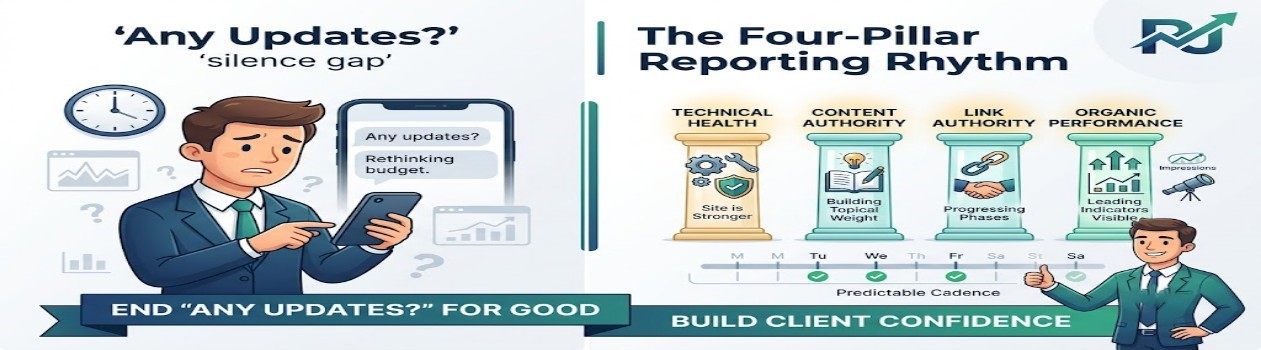
What happens: The monthly reporting cadence is agreed upon. The report format is walked through so the client understands how to read every metric before the first report arrives. The proactive mid-campaign check-in at day 45 is confirmed. The escalation contact is defined. Response time SLAs are set.
The client knows exactly when they will hear from the agency, what that communication will comprehensively cover, and how to raise something urgent without it defaulting to an angry email that sits in a general inbox for 48 hours.
What it prevents: The dreaded “any updates?” email. Client anxiety filling the communication vacuum. Reactive, defensive account management replacing proactive relationship management.
Output: A Communication Protocol document both parties reference throughout the engagement. There is zero ambiguity about the relationship rhythm.
The Onboarding System as a Scalable Agency Asset
The most common objection to adopting a structured, rigorous onboarding process is time. Most agencies are already at operational capacity. The idea of adding five highly structured stages to every single client intake sounds like a massive, unmanageable operational investment.
Here is the reframe: a structured onboarding system saves time—it does not cost it.
Every single hour invested in onboarding returns multiple hours saved in mid-campaign conflict management, scope dispute resolution, and frantic account recovery conversations. The agencies that skip onboarding are not saving time. They are simply borrowing it at an exorbitant interest rate from a future that inevitably arrives at month 4.
Furthermore, this entire process must be productized.
| Onboarding Stage | Estimated Time | Implementation Strategy |
| Stage 1: Discovery | 60–90 mins | Run strictly via template. No preparation from scratch. The output document is partially auto-populated during the call. |
| Stage 2: Scope | 30–45 mins | Utilize a master Scope & Exclusions template with service-specific modules toggled on or off per client. |
| Stage 3: Education | 20 mins | A recorded 45-minute walkthrough runs asynchronously. The client watches before the kickoff call. The live session is Q&A only. |
| Stage 4: Milestones | 30 mins | Pre-populated standard benchmarks, customized slightly with client-specific targets gathered in Stage 1. |
| Stage 5: Comm Protocol | 10 mins | A standard one-page operational document personalized with the client’s name and account manager. |
Total investment per client intake: 3 to 4 hours, with almost all of it being template-driven.
The first time you build this infrastructure, it costs more time. Every subsequent intake is faster. By your tenth client, the system runs flawlessly in under 2 hours.
To help visualize how to track this across multiple accounts, here is an interactive breakdown of the workflow:
Conclusion
The agency that deeply structures its onboarding process is not adding unnecessary bureaucracy. It is building the reinforced concrete foundation for every single client relationship that follows.
A client who enters the campaign with a crystal clear scope, agreed-upon milestones, a formal education in what the process is actually building, and a rigidly defined communication rhythm is a fundamentally different client to manage than one who arrived with assumptions, blind hope, and a 30-day mental deadline.
The former stays for years, refers their network, and trusts the data. The latter leaves angrily at month 4—and tells other business owners why your agency “didn’t work.”
If you want to see exactly how RankJacker structures its onboarding process—including the specific education modules, the milestone agreement framework, and the communication protocol documents—the walkthrough below shows the exact system we run across all of our agency partner accounts. We offer this not as a model to blindly outsource to, but as a robust operational model to learn from, adapt, and replicate.
Book a free Agency SEO Process Walkthrough to see the onboarding system behind 200+ agency partner accounts. No pitch. Just the process.
[Book Your Free Agency SEO Process Walkthrough]
10 Frequently Asked Questions About SEO Client Onboarding
Q1. Why is SEO client onboarding so important?
Ans. Onboarding is the critical phase where you align expectations, define the exact scope of work, and educate the client on the timeline. Without it, clients measure success using assumptions, which almost always leads to early cancellation when immediate rankings do not materialize.
Q2. How long should an SEO onboarding process take?
Ans. While the timeline spans the first week or two of engagement, the actual agency labor should take 3 to 4 hours per client. This is achieved by utilizing pre-built templates, standardized scope documents, and asynchronous video education.
Q3. What is the biggest mistake agencies make during onboarding?
Ans. Treating onboarding purely as an administrative task (getting passwords and signing contracts) rather than an educational and alignment process. The biggest failure is not clearly defining what success looks like and how long it will take to build the capacity to achieve it.
Q4. How do I handle a client who refuses to watch the education module?
Ans. Make it a contractual prerequisite to the official kickoff call. If a client is unwilling to invest 45 minutes to understand the strategy they are paying thousands of dollars for, they are a massive flight risk. Address it respectfully but firmly during Stage 1.
Q5. What is a “Scope & Exclusions” document?
Ans. It is a formal agreement that details not only what you will do, but explicitly what you will not do (e.g., website redesign, paid ads, CRO). It also defines exactly what the client must provide (content approvals, logins) and what happens to the timeline if they delay.
Q6. Should we guarantee rankings during the milestone agreement?
Ans. Never guarantee specific keyword rankings. Instead, commit to operational milestones and leading indicators (e.g., “Foundation Complete with 90% crawlability by Month 2,” or “20% impression growth on supporting queries by Month 4”).
Q7. How do I onboard white label SEO clients?
Ans. If you are an agency using a white label provider, the onboarding framework remains the same between you and your end-client. The white label provider should supply you with the milestone benchmarks, technical capacity data, and reporting structures so you can confidently lead the client-facing onboarding.
Q8. What happens if a client wants to change the scope mid-campaign?
Ans. Because you have a signed Scope & Exclusions document, you simply refer back to it. Acknowledge the new request, explain that it falls outside the current agreement, and offer to price it as a separate project or an add-on to the existing retainer.
Q9. How do we prevent the “any updates?” email from clients?
Ans. By establishing a strict Communication Protocol in Stage 5. If the client knows they receive a comprehensive report on the 1st of the month and a proactive video check-in on the 15th, the anxiety that drives the “any updates?” email disappears.
Q10. When does onboarding officially end and the campaign begin?
Ans. Onboarding concludes when the Communication Protocol is signed and the Stage 1-5 deliverables are complete. However, the first 60 days (Milestone 1) are functionally an extension of onboarding, as you are building the technical and structural capacity needed for the campaign to thrive.