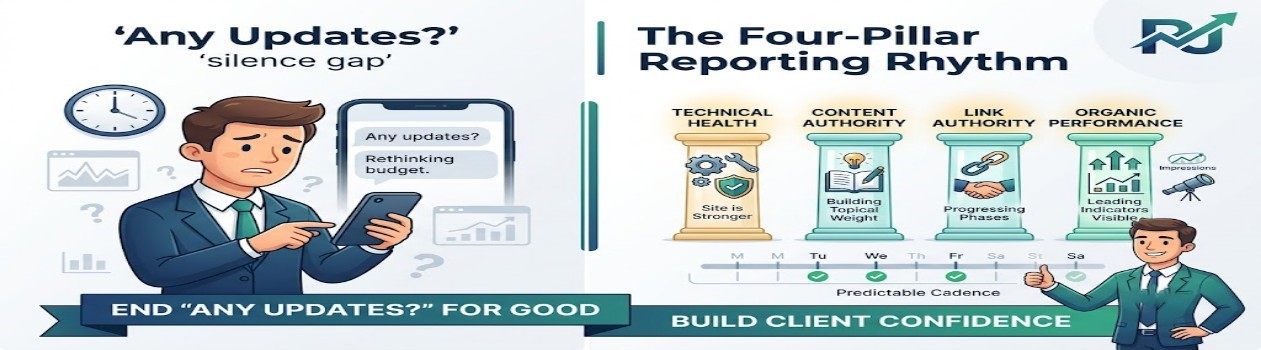
It’s month three. The campaign is running. You’ve fixed crawl errors, built a dozen solid links, published seven pieces of content, and the technical foundation is the strongest this site has ever had. Then the email arrives.
“Hey — we wanted to check in. Rankings haven’t really moved yet and we’re wondering if we should hit pause for a bit to reassess.”
You’ve seen this email before. You’ll see it again. And the worst part isn’t the churn — it’s that you know the compounding is coming. You know that months four through nine are where this campaign pays off. You know that everything built so far is the reason those months will work. And you’re about to lose the account anyway.
This isn’t a results problem. It’s a systems problem. And it started before you sent the first deliverable.
Client churn before SEO compounds is almost never about performance. It’s about three structural gaps — misset expectations, invisible progress, and output-focused reporting — that create the conditions for cancellation regardless of the quality of the work. Every one of these gaps is solvable. None of them require faster results. By the end of this piece, you’ll have a complete framework for diagnosing why clients leave, a clear language for talking about early-phase progress, and three systems you can implement before the next campaign goes live.
The Three Structural Gaps That Cause Early Churn
Before blaming the client or the timeline, it’s worth running a proper diagnosis. In almost every early churn case, the same three structural gaps show up — not because the agency was incompetent, but because these gaps are easy to miss and rarely discussed.
Gap 1 — The expectation was never mapped.
The client was sold on an outcome: more traffic, better rankings, leads from search. Nobody walked them through the journey between signing and that outcome. Months one through three look nothing like months six through nine — technically, strategically, or in terms of visible signals. If the client doesn’t understand that before they sign, month three will feel like failure no matter what the agency has delivered. The benchmark they’re measuring against is the sales conversation, not a realistic campaign roadmap.
Gap 2 — Progress is invisible.
Early-phase SEO is almost entirely capacity building — fixing what’s broken technically, building content that earns topical depth, acquiring links that establish legitimate authority signals, and creating the conditions Google needs to start trusting the site. None of this shows up on a ranking dashboard in month two. The client opens the report, sees flat lines where they expected upward curves, and draws the most logical conclusion available to them: nothing is working. The agency, meanwhile, has done some of the most important work of the entire campaign. That gap between actual progress and visible progress is where confidence goes to die.
Gap 3 — The agency is reporting outputs, not progress signals.
“Eight links built. Here are the domains and their DRs.” That’s a task report. It answers the question “did we do the work?” — not “is the site getting stronger?” These are different questions, and clients care about the second one. Output reporting is the path of least resistance for most agencies because it’s easy to compile and easy to justify. But it puts the burden on the client to connect the dots between a list of link placements and the eventual ranking movement they’re waiting for. Most clients can’t make that connection. Most clients shouldn’t have to.
Each of these gaps is preventable. But prevention requires building systems before the campaign starts — not scrambling to explain results after the client is already frustrated enough to write that email.
The Four Dimensions of SEO Capacity — And Why Rankings Are the Last Thing to Show Up

Here is the reframe that changes everything: capacity building is not a delay. It is a billable, measurable, reportable campaign milestone — and it is the legitimate benchmark for every month before ranking movement arrives.
Most agencies never tell their clients about capacity building because most agencies have never thought about it clearly enough to explain it. But once you have the language, the early months of a campaign stop being a liability and start being a story. A measurable, specific, compelling story.
SEO capacity has four distinct dimensions, each of which can be tracked and reported from day one.
Dimension 1 — Technical Capacity
Crawlability, indexation, site architecture, Core Web Vitals, schema implementation. Google cannot rank what it cannot reliably access. A site with a 60% crawl coverage rate, five hundred redirect chains, and a PageSpeed score of 34 has a structural ceiling on its ranking potential — regardless of how many links are built or how good the content is.
Fixing technical foundations in months one and two is invisible in a ranking dashboard and foundational to every gain that follows. But it is not invisible if you report it correctly. A site that went from 61% crawlable in month one to 94% crawlable in month three has made measurable, documentable, predictive progress. That number directly predicts future ranking capacity. It is a result — just not the kind that shows up in a position tracker.
Dimension 2 — Content Capacity (Lifecycle Coverage)
Content strategy in the early campaign phase is not about publishing volume. It is about lifecycle coverage — building topical depth that matches where prospects actually are in their buying journey: awareness, consideration, decision.
The high-value, high-intent keywords — the ones the client came in talking about — are not realistic targets on day one. They are earned. You earn the right to rank for flagship terms by first establishing authority across supporting terms, building topical clusters, and demonstrating to Google that this site has genuine depth in its subject matter. That is a three-to-six-month architecture exercise. The flagship keywords get targeted after the foundation is established, not before.
Reporting content capacity means showing: topical cluster expansion, content gap closure, supporting keyword targeting by lifecycle stage, and the progressive build of the site’s authority footprint. Every piece of content published is a measurable signal — visible and reportable before a single organic traffic spike appears.
Dimension 3 — Link Authority Capacity
Link building in the first ninety days of a campaign operates in the Establishment phase of the Link Authority Life Cycle™. The links being built at this stage are foundational — citations, brand signals, contextually relevant placements that tell Google this is a real, legitimate business in a real niche. These are not the links that move target keywords directly. They are the links that make every subsequent placement more effective, more stable, and more resistant to algorithm volatility.
The anchor profile is built in deliberate sequence — Establishment, then Expansion, then Consolidation — and that sequence cannot be skipped without creating volatility that undermines the entire campaign. An agency that rushes to anchor-rich money links in month one is not accelerating results; it is building on sand.
Reporting link capacity means showing: referring domain velocity over time, anchor distribution health across the profile, lifecycle stage progression, and the topical relevance of placements relative to the site’s target category. A client can see their site moving through Establishment toward Expansion with documented signals at each stage. That progression is a result. It just requires someone to explain it as one.
Dimension 4 — Authority and Brand Signal Capacity
Brand search volume, editorial mentions, topical coverage depth. This is the dimension that is hardest to attribute directly and most important to get right — because it reflects how Google reads the site as an entity. A site with growing brand search volume, increasing editorial mentions across relevant publications, and deepening topical coverage is becoming a known entity in its category. That recognition shows up six months later in ranking stability and algorithm resilience.
This dimension is the output of everything above working together. It cannot be manufactured directly; it emerges from consistent execution across technical, content, and link capacity over time.
“Capacity building is the benchmark most agencies never tell their clients about — because most agencies never thought about it themselves. But build it correctly and consistently, and the client cannot ignore the traction when it arrives. They also cannot credibly attribute it to anything else.”
The Wrong-Client Filter
There is a client profile that no amount of capacity building communication will satisfy — the prospect who needs ranking movement or direct revenue impact within sixty to ninety days. That client is not wrong to want results. They are wrong for SEO, and more importantly, wrong for a long-term agency relationship.
The most important retention conversation you will ever have is the one before the client signs.
If a prospect signals that their timeline is ninety days, name it at the outset — not defensively, but honestly. Something like: “SEO is not the right vehicle for a ninety-day revenue target. Here is what it achieves over six to twelve months, and here is why that timeline is structural rather than arbitrary. If that doesn’t fit your current situation, I’d rather tell you now than build a relationship that creates pressure on both sides.”
The clients who send the month-three pause email were almost always brought on with misaligned expectations. The ones who were told the truth upfront either signed knowing what they were getting into, or they didn’t sign at all. Both outcomes protect the agency. Letting a wrong-fit prospect walk at the outset is not a lost sale. It is a protected retainer book and a protected reputation.
Rankings Are a Lagging Indicator. These Are the Leading Ones.
The reason clients lose confidence in month three is that they were taught to measure SEO through one lens. When that lens shows nothing — when the ranking dashboard is flat — the entire investment feels like it might be a mistake. The agencies that retain clients through this phase do not deliver faster results. They shift the measurement model at onboarding, before the flat line ever appears.
This means reporting across four pillars, every single month, from the first report.
Pillar 1 — Technical Health
Crawl coverage percentage, index ratio, page speed scores, Core Web Vitals pass rate, schema implementation status. All of these are measurable from month one. All of them improve as foundational work is done. All of them tell a story of structural capacity being built under the surface — a story the client can follow even when position trackers show no movement.
Pillar 2 — Content Authority
Topical cluster expansion (how many supporting terms are now being actively targeted), content gap closure (what was missing that now exists), lifecycle-stage coverage (awareness, consideration, decision content ratios), and supporting keyword performance across the full cluster. Each piece of content published is a documented expansion of the site’s authority footprint. Show it as one.
Pillar 3 — Link Authority
Referring domain growth rate month-over-month, anchor distribution health across the profile, lifecycle stage progression aligned with the Link Authority Life Cycle™, and topical relevance scoring of placements. A client who understands that their site has moved from Establishment into the early Expansion phase — with documented anchor distribution and velocity data — is watching a process unfold. That is fundamentally different from watching a list of domain ratings and wondering if they matter.
Pillar 4 — Organic Performance
Impressions growth in Search Console, click-through rate movement by query type, and — critically — ranking distribution across the full long-tail cluster, not just the handful of flagship target keywords. Position twenty to thirty movement across forty supporting terms in months two through four is far more meaningful signal than one flagship term sitting at position twelve. It is also almost always happening while the primary targets appear completely flat. If it’s not being reported, the client has no way to know it.
When every monthly report covers all four pillars, the client never encounters a flat line. They see a site becoming measurably stronger across every dimension that predicts the outcome they are waiting for. The month-three pause email becomes much harder to write when the report shows crawl health at ninety-four percent, twelve new supporting-term rankings entered, referring domains up by twenty-three, and impressions growing at eleven percent month-over-month.
Retention Is Won or Lost in the First 30 Days
The three systems below are not difficult to build. They are difficult to prioritise when the default is to focus entirely on delivery. But agencies that implement all three see a structural shift in retention — not because the results arrive faster, but because the client relationship is built on a foundation that can hold through the months where results are still forming.
System 1 — The Expectation Agreement
Before any work begins, the client receives a milestone map. Not a guarantee of outcomes — a narrative of what the campaign will look like at each phase, what will be built, why certain things will appear flat while foundational work is happening, and when specific types of movement become realistic.
Month one and two: what is being built and why it is invisible on a ranking dashboard. Month three through five: what early signals to watch across the four reporting pillars, and what those signals mean. Month six onwards: what compounding looks like and when flagship keyword movement becomes a realistic expectation.
When the client has this document — reviewed, understood, and agreed to at onboarding — they stop measuring the campaign against the sales conversation. They start measuring it against the roadmap. That shift removes the month-three crisis from the equation, because the client already knows month three is supposed to look like this.
System 2 — Leading Indicator Reporting
Every monthly report covers all four pillars. Technical health improving. Content coverage expanding. Link authority progressing through lifecycle stages. Organic impressions trending upward. None of these require target keywords to have moved. All of them tell a coherent story of a site becoming demonstrably stronger.
This is not complicated to produce. It requires pulling data from four sources instead of one, and framing that data as a narrative rather than a task log. The return on that investment — in client confidence, in reduced account management overhead, in renewals — is disproportionate to the effort.
System 3 — The Proactive Mid-Campaign Check-in
This is the simplest system and the one most agencies skip entirely.
At day forty-five — not triggered by a client question, not in response to a “checking in” email, but proactively initiated by the agency — the client receives a brief call or voice note. Not a report. Not a meeting. A narrative: here is where we are, here is what we’ve seen this month, here is what we’re watching in the next thirty days.
This single action eliminates the “any updates?” email before it’s written. And the “any updates?” email matters, because the client who sends it is already at an anxiety threshold. They’ve been sitting with uncertainty long enough that they’ve had to reach out. That threshold is very close to the threshold at which they start considering whether to pause.
The client who has been proactively told what’s happening — without asking — never reaches that point. They have been given the narrative before they needed to construct one themselves. The relationship is still in the agency’s hands.
The Communication Architecture That Makes Results Stick
The agencies that retain SEO clients for twelve months and beyond are not the ones who get lucky with early ranking movement. They are the ones who built the communication architecture before the campaign started — so that when results are slow to show, the client already knows what slow is supposed to look like.
Capacity building is real work. The four dimensions — technical, content, link authority, and brand signal capacity — are measurable at every stage. Four-pillar reporting makes that measurement visible. And the three systems — the expectation agreement, leading indicator reporting, and the proactive check-in — create a client relationship built on understanding rather than hope.
One diagnostic question worth asking after every client onboarding: does this client have everything they need to stay patient for the next six months? Do they have the roadmap, the reporting framework, and the proactive communication rhythm that will carry them through the months before compounding arrives?
If the answer is no, the retention problem has already started. The month-three pause email was written the day the onboarding call ended.
If you want to see how RankJacker structures this communication layer for agency partners — including the 4-pillar reporting framework, the Link Authority Life Cycle™ in practice, and lifecycle-aligned link delivery — we’re happy to walk you through it. No pitch. Just 30 minutes of actual strategy.
Book a Free Strategy Call →
Here is a streamlined, highly scannable version of your FAQs that retains all the core insights without the fluff:
Frequently Asked Questions
Q1. How long does SEO typically take before clients start seeing results?
Ans. 4 to 9 months. Months 1–3 focus entirely on foundational work—technical fixes, content architecture, and link establishment. While these early updates don’t immediately move rankings, they are critical for determining how quickly and sustainably rankings will eventually grow.
Q2. What is the single biggest reason SEO clients cancel early?
Ans. Misaligned expectations. If a client believes meaningful rankings will appear in 60 to 90 days, month three will feel like a failure regardless of the agency’s actual performance. Early cancellations are almost always the result of a poor onboarding conversation.
Q3. What does “capacity building” mean in an SEO context, and why should clients care?
Ans. It is the foundational work that creates the conditions for future rankings. This includes fixing technical crawlability, building content depth, and establishing link authority. Clients must understand this phase because it allows them to stay patient while the groundwork for long-term success is laid.
Q4. How should agencies report progress before rankings improve?
Ans. Agencies should report monthly across four key pillars:
a) Technical Health: Crawl coverage, Core Web Vitals, index ratios.
b) Content Authority: Topical clusters, content gaps.
c) Link Authority: Domain velocity, anchor distribution.
d) Organic Performance: Impressions growth, CTR trends.
This proves to the client that the site is growing measurably stronger before rankings climb.
Q5. What is the Link Authority Life Cycle™ and why does the sequence matter?
Ans. It is a three-phase link-building framework: Establishment, Expansion, and Consolidation. Following this sequence mimics natural growth and builds durable authority. Skipping straight to keyword-rich links before a foundation is built creates ranking volatility rather than traction.
Q6. Is there a type of client that SEO will never work for?
Ans. Yes, clients who need immediate revenue. SEO is a compounding investment, not a rapid-response channel. Businesses requiring leads within 60 to 90 days should be directed to paid channels rather than accepted into an SEO campaign where they are guaranteed to churn.
Q7. What is the Expectation Agreement and how does it prevent churn?
Ans. It is a milestone map delivered before the campaign begins. It outlines exactly what to expect in each phase—from the “invisible” early months to realistic month-six goals. This shifts the client’s focus from instant rankings to the long-term roadmap, removing the trigger for early cancellation.
Q8. How often should agencies proactively communicate with SEO clients?
Ans. Provide a monthly report, plus a proactive mid-campaign check-in. Reaching out around day 45 with a quick update prevents client anxiety and eliminates the dreaded “Any updates?” email.
Q9. Can a white-label SEO partner help agencies improve client retention?
Ans. Yes. A reliable white-label partner provides consistent delivery and structured reporting frameworks. This gives the agency a systematic basis for client communication, solving the two main causes of churn: poor communication and inconsistent execution.
Q10. What is the most important question to ask after every client onboarding? Does this client have everything they need to stay patient for the next six months?”
Ans. If they lack a clear milestone map, a solid reporting framework, or a proactive communication schedule, the risk of early cancellation is already high.