There are two distinct promises the SEO industry makes that systematically fail clients. The first is the aggressive, sales-driven hook: “You’ll see results in 30 days.” The second is the defensive, agency-protecting caveat: “SEO is a long-term strategy — give it 9 to 12 months.”
Both of these statements are designed to manage expectations. In reality, both of them destroy expectations. One creates a false sense of urgency that no sustainable strategy can meet, while the other gives a service provider cover to deliver absolutely nothing of value for three quarters of a year.
Let us be completely honest about the latter: A client waiting 9 to 12 months with no worthwhile organic standing is not experiencing “SEO taking time.” They are experiencing a campaign that was never properly structured to produce incremental results. The service provider who allowed that scenario to unfold is not a victim of client impatience; they are fully responsible for the outcome.
SEO results do not arrive all at once. They are meticulously planned, constructed, and built incrementally against a pre-defined strategy. When the approach is mathematically correct and the effort is highly focused, progress shows up gradually, consistently, and undeniably. The client cannot ignore it. That is a fundamentally different experience from blindly waiting and hoping.
By the end of this article, you will understand exactly why both ends of the standard SEO results timeline agency spectrum fail, what a true milestone-based SEO process looks like, and how to talk about results in a way that builds unshakeable client trust instead of slowly eroding it.
The 30-Day Myth and the 9-Month Cover — Two Sides of the Same Problem
When clients ask, “How long does SEO take?”, agencies usually default to one of two extreme narratives. Both are fundamentally flawed.
The 30-Day Promise
Let’s clear the air: there is absolutely no legitimate SEO process that produces meaningful, sustainable organic results in 30 days.
Technical fixes, no matter how efficiently deployed, take time for Google to crawl, render, and re-index. Content requires time to establish true topical authority within a cluster. Link authority—as we meticulously outline in our [Link Authority Life Cycle™ ebook]—develops through strict sequential phases. These phases cannot be skipped, rushed, or artificially inflated without creating massive ranking volatility and risking algorithmic penalties.
Anyone promising 30-day ranking results is doing one of three things: they are quietly selling PPC and passing it off as organic, they are manipulating vanity metrics on zero-volume keywords, or they are building on a fragile foundation that will inevitably collapse.
The damage this 30-day myth does to the agency-client relationship is catastrophic. It sets a benchmark that the campaign can never realistically meet. It triggers immediate client anxiety in month 2 when the flagship keywords haven’t miraculously jumped to page one. Ultimately, it puts the agency in a permanent, exhausting defensive position long before the real compounding effects have even begun.
The 9–12 Month Vagueness
The opposite failure is subtler, but arguably much more dishonest. Telling a client that “SEO takes 9 to 12 months” without providing a rigid milestone structure gives the agency a blank check to deliver inconsistently for three quarters of a year.
In this scenario, there is no checkpoint. There is no visible progress. The client has merely been given a timeline, not a process.
The result of this vagueness is seen repeatedly across the industry: the client waits with diminishing patience. The agency keeps delivering outputs without ever measuring incremental impact. At month 7 or 8, the relationship fractures under the heavy weight of expectations that were never concretely defined. The client feels cheated; the agency defensively points to the “12-month rule.” Both parties are partially right—and the entire situation was entirely preventable.
The honest position is neither 30 days nor 12 months. The honest position is: “Here is exactly what we will build in each phase, here is how you will see it progressing month-over-month, and here is the benchmark that tells us whether the strategy is working at every single stage.”
Incremental, Planned, Constructed — Not Sudden
Results in SEO are not an event. They are an accumulation.
Each month of correctly executed, focused effort adds a vital layer to the authority structure the website is building. No single layer produces a dramatic, overnight ranking movement. However, all of them together produce compounding incremental SEO results that become self-reinforcing—and increasingly difficult for competitors to replicate or outrank.
The key word here is correctly. Consistent effort applied against the wrong strategy does not compound; it simply accumulates waste. The focus of the effort matters just as much as the consistency.
What Month 1–2 Produces
The first 60 days are entirely about foundation and capacity.
- Technical Capacity: Crawlability, indexation rules, Core Web Vitals, and site architecture are systematically resolved.
- Content Architecture: We execute lifecycle-stage keyword mapping (awareness, consideration, decision) so the right content is being built for the exact right prospect at the right moment in their buying journey. High-value, high-intent keywords are identified but not targeted yet. The foundation is being set to earn the right to rank for them later.
- Link Foundation: This is the Establishment phase. We focus on brand signals, core citations, and early contextual links that establish brand legitimacy before we ever attempt to claim topical authority.
What Month 3–5 Produces
This is the phase of visible leading indicators.
- Traction Signals: Impressions begin growing across long-tail query clusters. Topical coverage expands visibly.
- Authority Progression: Link authority progresses from the Establishment phase toward the Expansionphase. Supporting keywords slowly begin to climb the SERPs.
- Lifecycle Coverage: The content lifecycle coverage becomes strong enough for the site to start earning consideration-stage traffic.
The compounding effect is not necessarily dramatic yet, but the upward trend line is undeniable to anyone tracking the right metrics.
What Month 6+ Produces
This is the compounding phase. Target keyword movement finally begins in earnest because the authority foundations built in the earlier phases start to tightly reinforce each other. Organic traffic growth becomes self-sustaining.
Most importantly, client confidence shifts from trust-as-faith to trust-as-evidence. This is where a correctly run SEO campaign stops needing to be constantly explained and defended, and starts speaking for itself in the analytics.
The critical observation for any agency is this: if month 6 results are not showing up, the problem is almost never that SEO “just takes longer.” The problem is buried in months 1 through 4. It means the right capacity wasn’t built, the strategy lacked focus, or the effort wasn’t consistent. Month 6 results are produced by month 2 decisions.
“Results don’t show up suddenly after a long wait. They are planned, constructed, and built incrementally. If an agency’s approach is right and their effort is focused — progress shows up gradually, not all at once. And a client cannot ignore gradual, consistent progress.”
Replace ‘It Takes 9 Months’ with This
To properly manage expectations and maintain trust, you need SEO milestones, not vague timelines.
Milestone 1 — Foundation Complete (End of Month 2)
The site is technically flawless and the structural blueprint is laid.
- Deliverable: Technical audit fully resolved. Content architecture mapped and the initial lifecycle content is published. Link authority Establishment phase is underway (brand citations, foundational placements, anchor distribution set correctly).
- Benchmark: Crawl coverage above 90%, 6–8 supporting content pieces live, 15–20 Establishment-phase links placed and indexed.
Milestone 2 — Traction Signals Visible (End of Month 4)
Google is actively testing the new authority foundation.
- Deliverable: Organic impressions growth is measurable across the long-tail cluster. Supporting keyword positions are moving upward. Content lifecycle coverage is expanding into the consideration stage. Link authority is transitioning toward the Expansion phase.
- Benchmark: 20%+ impression growth on supporting queries, 3–5 keywords entering top-30 positions, topical cluster coverage at 60%+ of the planned architecture.
Milestone 3 — Compounding Begins (End of Month 6)
The foundation translates into bottom-line movement.
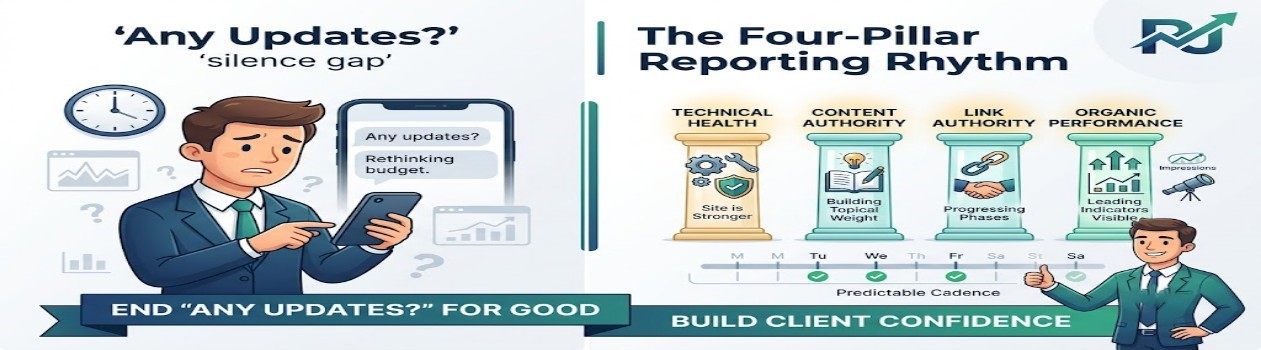
- Deliverable: Target keyword movement becomes visible. Organic traffic from supporting terms actually starts converting. Authority signals are reinforcing across all 4 pillars (technical, content, link, performance).
- Benchmark: Target keywords entering the top-15, organic click volume from the long-tail growing month-over-month, the client reporting inbound leads directly traceable to organic search.
Milestone 4 — Momentum Phase (Month 6 Onward)
This is not a fixed endpoint; it is a new operational reality. It is the phase where compounding becomes truly self-sustaining, and the overarching strategy shifts from building authority to defending and extending it. New keyword targets open up as the existing domain profile earns credibility. Content investment deepens into highly specific niches. The link strategy aggressively evolves from Expansion into the Consolidation phase.
The milestone framework does not magically replace the 9-to-12 month reality of SEO. Rather, it gives both the agency and the client a highly structured, objective way to experience and verify that reality as it naturally unfolds—instead of holding their breath for a deadline that may or may not deliver.
What to Say Before They Sign — Not After They’re Frustrated
The most important conversation you will ever have with a client is the one that prevents every single retention problem that follows. Before a contract is signed, you must directly manage SEO client expectations by explicitly naming three things:
- What SEO cannot do in 30 days: Explain exactly why a lack of immediate ROI is not a failure, but rather a structural reality of how digital authority is built and validated by search engines.
- What they will see happening every month for the first 6 months: Use the milestone framework detailed above as a shared, contractual reference point, rather than relying on a vague promise of “future traffic.”
- What the benchmark for ‘working correctly’ looks like at each stage: Ensure both parties have a documented, agreed-upon definition of progress that does not rely entirely on flagship keyword rankings.
The clients who are actually worth keeping are the ones who listen to this conversation and respond with: “That makes logical sense. Let’s start the process.”
The clients who push back and respond with: “But can we see results faster if we pay more?” are waving a massive red flag. Name the mismatch right then and there. A bad-fit client let go at the proposal stage costs you one hour of meeting time. A bad-fit client let go at month 4 costs you the retainer, the internal team’s morale, your relationship, and your agency’s reputation.
There is also a strict direct responsibility on the agency side. If a client has patiently waited 9 months and still has no worthwhile organic standing, looking them in the eye and asking them to “just be a little more patient” is not a strategy. It is an avoidance of accountability. The milestone framework exists precisely to prevent this exact scenario. With milestones, every single month is either on track or it is not, and both parties know exactly which it is.
Conclusion
The 30-day promise and the 9-month vagueness are both profound failures of the exact same system—an agency system built entirely around timeline promises instead of milestone commitments.
The agencies that actually retain their clients and produce undeniable, compounding organic results are not the ones who found a cheat code to deliver faster. They are the ones who clearly defined what incremental progress looks like before the campaign ever started. They then built that progress, month by month, without ever letting either party drift into uncertainty or doubt.
If you want to see exactly how RankJacker’s proprietary SEO process is structured—from the initial technical foundation, through the Establishment-phase link authority, all the way to compounding organic growth—we pull back the curtain completely. If you scale using a [White Label SEO page] or build in-house, the structure remains the same. Check out our [Pillar 3 blog post] for more context on execution.
Book a free Agency SEO Process Walkthrough to see the exact system we run across all of our agency partner accounts to produce planned, incremental, and verifiable results. No pitch. Just the process.
[Book Your Free Agency SEO Process Walkthrough]