
Let’s be honest, an old-school SEO checklist just doesn’t cut it anymore. If you want to compete, you need a dynamic SEO strategy template. Think of it as the roadmap that guides every single decision you make, from digging into audience research all the way to measuring your performance. It’s what turns reactive, scattered tactics into a real, proactive plan for growth that actually lasts.
Why Your Old SEO Template Is Failing
If you’re still clinging to a generic SEO checklist you downloaded a few years back, you’re almost certainly falling behind. The digital world has become incredibly crowded and complicated, which makes a structured, strategic approach more critical than ever. Just ticking off boxes for title tags and keyword density completely misses the bigger picture—things like user intent and what your competitors are actually doing.

The sheer explosion in search volume puts this challenge into perspective. Google’s annual searches are projected to leap from roughly 2.55 trillion in 2020 to an incredible 5.99 trillion by 2025. That’s a staggering 134% increase. It means way more competition and a much greater need for a coherent strategy to even get noticed. If you want to dig deeper, you can discover more insights on these search trends and see for yourself how they impact SEO.
Moving Beyond Checklists To Strategic Frameworks
A modern seo strategy template isn’t a static document you fill out once and forget. It’s a living, breathing framework for your entire organic marketing operation. It forces you to think systematically about how every piece of the puzzle fits together, making sure your actions are always purposeful and tied directly to your business goals.
“An effective template isn’t just about what you do; it’s about why you’re doing it. It connects your keyword research to your content calendar and links both to your revenue goals, creating a clear line from effort to impact.”
This shift in thinking means your template has to be built on a solid foundation. Before we dive into the template itself, it’s crucial to understand the pillars that hold up any successful SEO campaign.
Core Components Of A Modern SEO Strategy Template
Every robust SEO template should be built around these four essential pillars. They work together to create a true growth engine rather than just a collection of disconnected tasks.
| Component | Objective | Key Activities |
|---|---|---|
| Audience & Competitor Insights | To deeply understand your target audience and the competitive landscape. | Persona development, keyword gap analysis, SERP analysis, competitor backlink profiling. |
| On-Page & Technical SEO | To ensure search engines can easily find, crawl, and understand your site. | Site audits, schema markup, page speed optimization, internal linking, mobile-friendliness. |
| Content & Authority Building | To create valuable content and build your site’s credibility and trust. | Content calendar planning, topic clustering, link building outreach, digital PR. |
| Performance Measurement | To track progress, prove ROI, and make data-informed decisions. | KPI tracking (traffic, rankings, conversions), Google Analytics review, reporting. |
By organizing your efforts around these core areas, your template transforms from a forgotten file into an actionable roadmap. It’s the key to moving from just “doing SEO” to building a resilient, long-term asset for your business.
Build Your Foundation With Audience And Competitor Analysis
Every great SEO strategy starts with people, not keywords. I’ve seen it time and time again: folks jump straight into keyword research without first figuring out who they’re trying to reach and who they’re up against. It’s like building a house on sand. Sooner or later, the whole thing comes crashing down.
Before you even think about filling out a template, you need to get crystal clear on your audience and your true competitors.

The goal here is to ditch the generic assumptions and build some solid, data-driven user personas. These aren’t just make-believe characters; they’re based on the real behaviors and motivations of your ideal customers. Forget just jotting down age and location. What really matters are their pain points, their goals, and the exact language they’re using to search for solutions.
For example, a software company might assume people are searching for “project management software.” But after a little digging, they discover their audience is actually asking Google, “how to stop my team from missing deadlines” or “best way to track remote employee tasks.” This single insight completely changes how you’d approach your content.
Uncovering Audience Pain Points
To get your personas right, you need to do some detective work and mine for real, qualitative data. Stop guessing what your audience wants and start listening to what they’re already telling you.
Here are a few goldmines to get you started:
- Customer Service Logs: Your support tickets and chat histories are packed with recurring problems and questions.
- Sales Call Recordings: The sales team is on the front lines. Listen to the language prospects use to describe their challenges. It’s pure gold.
- Online Communities: Dive into forums like Reddit, Quora, or niche-specific Facebook groups where your target audience hangs out and vents their frustrations.
This process gives you the raw material—the exact phrases and emotional triggers—to flesh out the “Audience Persona” section of your SEO strategy template. It’s how you ensure your content will actually connect with people because it speaks directly to their real-world problems.
Pinpointing Your True SEO Competitors
Okay, so you know your audience inside and out. Now, who are you competing against? A classic mistake is to only look at your direct business competitors. Your real SEO competitors are any and all websites that show up for the keywords and topics your audience is searching for, even if they don’t sell a thing.
“A local bakery’s SEO competitor might not be the shop across town. It could very well be a national food blog that consistently ranks for “best chocolate chip cookie recipe.” Understanding this is a game-changer for your content plan.”
To find these rivals, just start Googling the pain-point-driven questions you uncovered earlier. The sites that keep popping up on page one? Those are your primary organic search competitors.
Now, it’s time to analyze what they’re doing right. Look for patterns:
- Content Formats: Are they ranking with long-form guides, short videos, or maybe interactive tools?
- Topic Gaps: What related questions are they not answering? Where are the holes you can fill?
- Authority Signals: How are they building trust? Do you see case studies, quotes from experts, or original data?
By dissecting what’s already winning, you can find your opening to create something better, more thorough, or with a unique angle they completely missed. This competitive intel is the final piece of the puzzle you’ll slot into your SEO strategy template, ensuring your plan is not only customer-focused but also positioned to actually win in the SERPs.
Structure Your Technical And On-Page SEO Pillars
You can create the most amazing, game-changing content on the planet, but if search engines can’t find, crawl, and make sense of it, it might as well not exist. This is where your technical and on-page SEO pillars come in—and they are completely non-negotiable.
Think of your website as the engine and your content as the fuel. If that engine is sputtering and broken, you’re not going anywhere, no matter how premium your fuel is.

First things first, you need to run a comprehensive site audit to see where you stand. This isn’t just about hunting for a few 404 errors. A proper audit, which you’ll document in your SEO strategy template, needs to dig into the serious stuff: Core Web Vitals, mobile usability, indexation status, and any crawlability roadblocks.
These aren’t just vanity metrics; they directly impact user experience and tell Google a lot about your site’s quality.
Prioritizing Your Technical Fixes
Once your audit spits out a list of issues, it’s easy to feel overwhelmed. The key is to prioritize. Let’s be real: not all technical problems are created equal. A sitewide indexation problem from a rogue noindex tag is a five-alarm fire. A handful of images missing alt text? That’s a smoldering campfire you can deal with later.
Your template should help you sort through the noise. I’ve always found a simple impact/effort matrix works wonders:
- High-Impact, Low-Effort: Get on these immediately. We’re talking about fixing a messed-up robots.txt file or clearing major crawlability blocks.
- High-Impact, High-Effort: These are your big-ticket projects. Think a complete site speed overhaul or finally migrating to HTTPS.
- Low-Impact, Low-Effort: Chip away at these when you have a spare moment. This could be minor on-page tweaks or optimizing a few images.
- Low-Impact, High-Effort: Honestly, these often aren’t worth the resource drain unless they’re tied to a larger strategic goal.
This approach turns a scary list of errors into an actionable roadmap. That’s the whole point of using a structured template in the first place.
Mastering On-Page Optimization Fundamentals
Once your site is technically sound, it’s time to zoom in on individual pages. This is where so many businesses drop the ball on easy wins. The data is pretty eye-opening. Did you know 7.4% of pages ranking in the top 10 don’t even have a title tag?
And it gets crazier. Google is now rewriting a whopping 76% of titles in the SERPs, which means crafting compelling, intent-focused titles has never been more critical. Add to that the fact that about 25% of small business sites are missing a proper H1 tag, and you can see how just nailing the basics gives you a huge competitive advantage. You can explore more SEO facts and figures to see just how common these slip-ups are.
“Don’t just write for bots. Your on-page elements—title tags, meta descriptions, and headings—are your first and best chance to convince a human to click. They must be compelling, accurate, and aligned with user intent.”
For instance, a generic title like “Our Services” does absolutely nothing for you. A much better title, “Boutique Landscaping Services in Austin | Free Estimates,” speaks directly to a user’s location, what they need, and their next logical step.
Your template should have dedicated columns to track the primary keyword, title tag, meta description, and H1 for every important page. This forces you to be intentional and ensure every single element is optimized with a clear purpose.
With a solid technical SEO foundation in place, it’s time to shift gears. Now we get to the fun part: building the high-impact content and authoritative links that actually drive growth.
This is where your SEO strategy template stops being about fixing problems and starts actively building your site’s reputation and visibility. If you think of your website as an engine, content is the fuel, and backlinks are the horsepower that leaves your competitors in the dust.
Your content plan can’t just be a list of random blog ideas you thought up in the shower. It needs to be strategic. Every single piece of content should have a clear purpose and map directly to a specific stage of your customer’s journey.
Mapping Content To The Buyer Journey
One of the biggest mistakes I see businesses make is creating content that only targets top-of-funnel, informational keywords. That’s great for getting eyeballs, but what about the people who are actually ready to buy? You’re leaving money on the table.
Your template needs to balance content across the entire customer lifecycle.
- Awareness Stage: This is where you create those in-depth guides and practical blog posts. You’re answering the big, broad questions your audience has. For a company selling project management software, a great piece would be something like, “How to Keep Your Remote Team from Descending into Chaos.”
- Consideration Stage: Now you start developing content that helps people compare their options. Think insightful case studies, direct product comparison articles, or detailed tutorials that subtly show off your product’s best features. This is your chance to show them why you’re the best choice.
- Decision Stage: Time to seal the deal. This content builds that final layer of trust and makes saying “yes” a no-brainer. This is where your pricing pages, implementation checklists, and glowing customer testimonials come into play.
By mapping out your keywords and content formats for each of these stages in your template, you’re not just creating content—you’re building a strategic narrative that guides people from “What is this?” to “Where do I sign up?”
Building Authority The Right Way With Link Building
Links are still a massive signal of authority to search engines, but the game has completely changed. Forget about spammy outreach emails and worthless directory submissions. That stuff doesn’t work anymore and can actually get you penalized.
Today’s link building is all about earning trust and citations by being genuinely valuable. The goal is to create assets so ridiculously useful that other high-quality sites want to link to you.
“Let me be clear: your link-building strategy must prioritize quality over quantity. One single, highly relevant link from a major industry publication is worth more than a hundred junk links from sites nobody’s ever heard of. This is about building a profile of trust, not just a high link count.”
Start by creating “link-worthy” assets. This could be original research, a data-packed report, or a free tool that solves a real problem for your audience. Once you have these valuable resources, you can start getting strategic—contributing expert insights to authoritative publications or using digital PR to land media mentions.
Finally, your template absolutely must have a section for tracking your backlink profile. You need to keep an eye on new and lost links. This is how you’ll know if your campaigns are working, spot new opportunities, and protect your site from any potentially sketchy links that pop up.
Choose Your Strategy Level And Measure Success
Let’s be real: not all SEO efforts are created equal. Tossing a few blog posts up and calling it a day is a world away from a sophisticated, authority-building campaign. A common mistake I see is teams treating every SEO activity the same, which leads to mismatched expectations and disappointment down the road.
Deciding on your strategy level before you start is crucial. It sets the stage for your team and tells stakeholders what kind of results they can realistically expect.
The ROI you get from SEO swings wildly depending on your approach. Basic content marketing might net you a respectable 16% ROI. A more targeted technical SEO fix-it campaign? That can jump to a much healthier 117% ROI. But if you’re playing the long game with a comprehensive strategy built on true thought leadership, you could be looking at a massive 748% ROI. These aren’t just vanity numbers; they show that a well-thought-out plan can deliver returns nearly five times higher than just going through the motions. If you want to dig into the data, you can learn more about these SEO ROI findings and see how different approaches stack up.
SEO Strategy ROI Comparison
To help you decide which path makes sense for your business, here’s a quick breakdown of what each level of investment typically involves and the kind of return you can expect.
| Strategy Type | Typical Activities | Estimated ROI | Time to Break-Even |
|---|---|---|---|
| Basic Content Marketing | Regular blogging, basic keyword targeting, social media promotion. | ~16% | 12-18 months |
| Technical SEO Focus | Site audits, page speed optimization, schema markup, fixing crawl errors. | ~117% | 6-9 months |
| Authority Building | In-depth content, link building, digital PR, thought leadership pieces. | ~748% | 18-24 months+ |
As you can see, the bigger the commitment, the bigger the potential payoff. The key is to align your choice with your budget, timeline, and overall business goals.
Defining What Success Actually Looks Like
Once you’ve picked your lane, you have to figure out how you’ll know if you’re winning. Flying blind without clear Key Performance Indicators (KPIs) is a recipe for disaster. Your template needs a dedicated spot for tracking the metrics that actually move the needle for your business.
“Your KPIs should tell a story that connects your SEO activities directly to business outcomes. It’s not about how many keywords you rank for, but how much qualified traffic, leads, and revenue that ranking is driving.”
Don’t fall into the trap of obsessing over organic traffic alone. It’s an important metric, sure, but it’s only one piece of the puzzle. A solid measurement plan looks at a balanced set of metrics to give you the full picture.
This chart really drives home the core pillars of any effective SEO strategy.
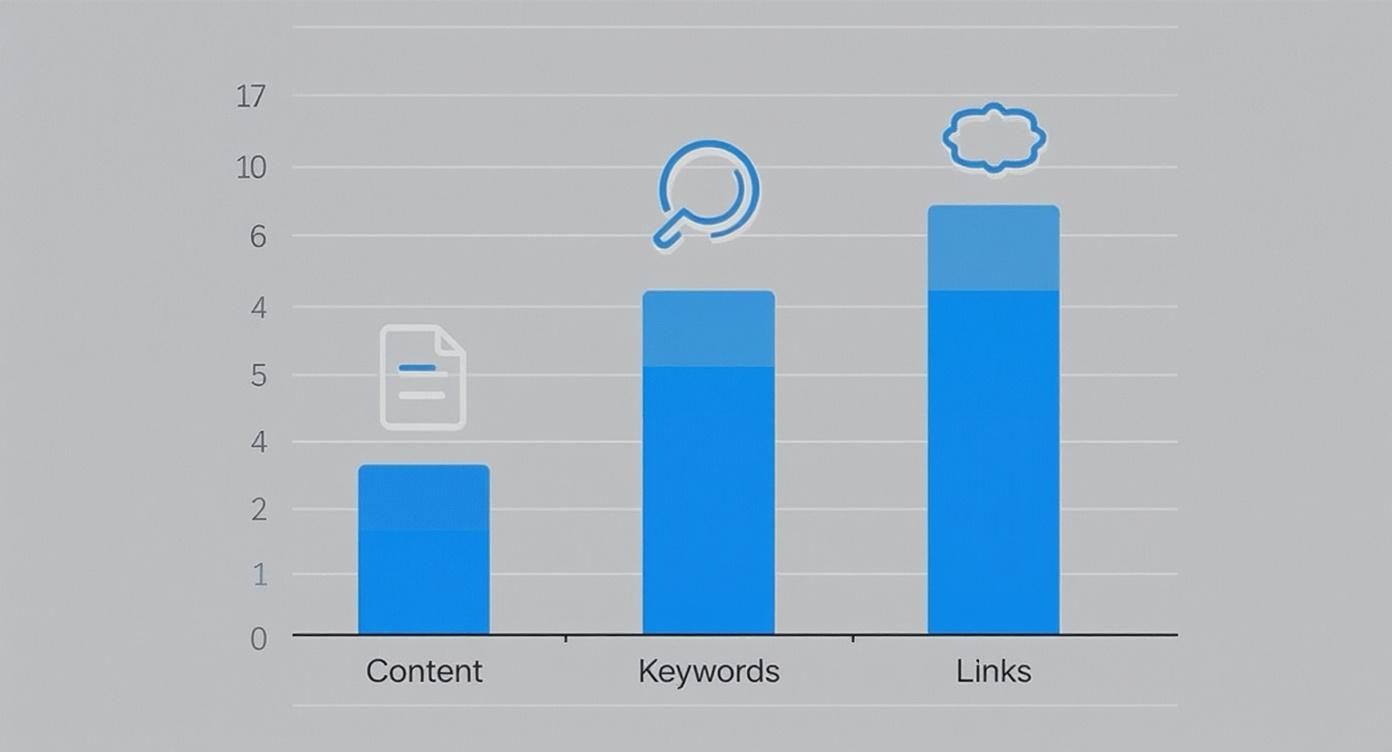
It’s a great visual reminder of how high-quality content, smart keyword targeting, and authoritative links all have to work together.
Setting Up Your Measurement Dashboard
To keep from getting lost in the data, I always recommend setting up a simple dashboard. Pull in the essentials from tools like Google Analytics 4 and Google Search Console to create a single source of truth for your campaign’s progress.
Here are the must-have KPIs I’d include in any template and dashboard:
- Organic Traffic Growth: Are you seeing positive month-over-month and year-over-year trends? This tells you if your overall visibility is heading in the right direction.
- Keyword Ranking Improvements: Forget tracking thousands of keywords. Focus on the ones with high commercial intent that will actually bring in customers.
- Conversion Rate from Organic Traffic: This is the big one. Are the visitors coming from search actually doing what you want them to do? Whether it’s filling out a form or buying a product, this metric proves your SEO is generating real business value.
- Backlink Profile Growth: Keep an eye on the number of new, high-quality referring domains you’re earning each month. Quality over quantity here is key.
- Click-Through Rate (CTR): When you see CTR going up for important terms in Search Console, it’s a great sign that your page titles and meta descriptions are hitting the mark with searchers.
By consistently tracking these core metrics right inside your SEO strategy template, you’ll be able to prove the value of your work, spot what’s working (and what’s not), and make smarter, data-backed decisions to keep improving.
Putting Your SEO Strategy Template Into Action
Alright, you’ve filled out the SEO strategy template. It’s not just a document anymore; it’s your living, breathing roadmap to real growth. Now the fun part begins: turning that plan into results you can actually measure.
Those first 90 days are absolutely critical. This is where you build momentum and score some early wins to show everyone this strategy has teeth.
https://www.youtube.com/embed/9l1SnCTKAMI
Don’t try to boil the ocean and tackle everything at once. That’s a classic mistake. Instead, be surgical. Go for the tasks that deliver the biggest bang for your buck right out of the gate.
A great place to start is by fixing any glaring technical problems you found in your audit—things like broken redirects or serious indexing issues. At the same time, pick a handful of high-potential “money pages.” These are usually your core service or product pages that are already sniffing around page one for valuable, commercial keywords. A little optimization here can go a long way.
Focusing on these quick wins often gives you a noticeable bump in traffic and conversions within just a few weeks. And trust me, nothing gets stakeholder buy-in faster than seeing those numbers tick up.
Create a Cadence for Review and Adaptation
Look, an SEO strategy is not a “set it and forget it” kind of deal. The search landscape changes constantly. To keep your efforts from going stale, you need to get into a regular rhythm of reviewing your performance and making smart adjustments.
This consistent schedule is what keeps your template relevant and ensures you’re making decisions based on real data, not just old assumptions.
“A template is a compass, not a rigid map. Its true power lies in its ability to guide your adjustments over time, helping you navigate changes in the SERPs and capitalize on new opportunities as they arise.”
Here’s a simple but incredibly effective cadence you can steal:
- Weekly Check-ins: Just 30 minutes. Jump into Google Search Console and look for the big stuff. Have rankings jumped or dropped? Any weird CTR changes? New crawl errors popping up? This is your early warning system.
- Monthly Performance Reviews: Time to go a bit deeper. Pull up your analytics and analyze organic traffic growth, conversion rates from your key pages, and how your new content is performing. This is the perfect time to tweak your content calendar based on what’s actually working.
- Quarterly Strategy Sessions: Now, zoom out. Take a high-level look at your progress against the main business goals. Are you on pace to hit your big targets? This is where you might decide to re-evaluate keyword priorities or plan a major initiative for the next 90 days.
Communicating Progress and Proving Value
Finally, you have to turn your data into a story that gets people excited. Don’t just slide a spreadsheet of rankings across the table; connect your SEO work to what the business actually cares about: money and growth.
Put together a simple monthly report that highlights the big wins.
For instance, instead of just saying, “We ranked for 10 new keywords,” frame it in business terms. Something like, “Our new blog post on ‘X’ just hit page one, driving an extra 500 qualified visitors and generating 15 new leads this month alone.”
When you talk like that, you’re translating SEO metrics into the language of revenue. It makes the value of your strategy impossible to ignore.
Got Questions About SEO Strategy Templates? We’ve Got Answers
Even with the best template in hand, you’re bound to have questions when you start putting it into action. It’s totally normal. Let’s walk through some of the most common ones I hear from clients and colleagues when they’re building out their SEO strategy.
Think of this as a quick-reference guide to clear up those nagging doubts so you can move forward with confidence.
How Often Should I Update My SEO Template?
This is probably the biggest question people have. Is this a “set it and forget it” kind of thing? Absolutely not.
Your SEO template should be a living document, not some static file collecting digital dust. It needs regular check-ins to keep you on track and make sure you’re not wasting effort on tactics that aren’t moving the needle.
“A good rule of thumb is to review your template quarterly. This gives you enough data to see what’s working and what’s not, allowing you to make smart, tactical adjustments. Then, block out time for a major overhaul once a year to realign with bigger picture changes—think major algorithm updates, new competitor moves, or a pivot in your own business goals.”
This cadence keeps your strategy nimble without sending your team into a constant state of flux.
Is One Part of The Template More Important Than The Others?
Everyone’s looking for the magic bullet, that one section that holds the key to ranking success. While every part of the template is interconnected, the entire strategy rests on one critical foundation: audience and competitor analysis.
If you skimp on this part or just skim the surface, everything else you do will be fundamentally flawed. It’s that simple.
Without a deep, almost obsessive understanding of who you’re talking to and who you’re up against, your keyword targeting, content creation, and technical fixes will be shots in the dark. Getting this right is the difference between a focused, effective campaign and just making noise online.
Is It Okay to Use a Pre-Made Template?
So, should you just grab a template off the internet and call it a day? Yes and no. You can absolutely use a pre-made template as your starting point, but it comes with a huge caveat: you must customize it.
A generic template downloaded from a blog post can’t possibly know your specific business objectives, your audience’s unique quirks, or the nuances of your competitive landscape.
Here’s how to approach it:
- Use it for structure: A pre-made template is great for getting ideas on how to organize your thoughts and data. It gives you the scaffolding.
- Fill it with your strategy: The real value comes when you fill that scaffolding with your own in-depth research, your data, and your strategic decisions. This is what makes it your plan.
This customization process is what transforms a generic document into a powerful tool that actually drives growth for your business. It ensures your plan is grounded in your reality, not someone else’s.